12:04 AM
The groom, Michael, was a hulking man, at least 350 pounds heavy, but his soft features made him look approachable, even friendly. His fade was neatly trimmed for the occasion, and he wore a sharp yellow tie along with his male peers. The cook had told me that Michael was a graduate. Michael’s wife was a tall, robust, but not obese white woman, who looked average-sized only next to her husband. I approached Michael as he left the dance floor, heaving and sweating, removing his tie.
“Congratulations, man.”
“Thanks, thank you.”
“I heard you graduated from here.”
“I did, class of 2000. And you?”
I told him I graduated this year, 2009. He immediately began to give me a life talk, which I hadn’t expected. He spoke exactly like a sports coach, trying to boost my morale.
“Hey, look, man, I know it’s tough right now, but give it a few years—just give it three, four years and you’ll realize that it was worth it. Your education here is just gonna put you ahead and you’re gonna be successful. I mean myself, all my friends who are here with me, they all went here too, and they’re all successful.”
He paused and seemed to lose his thought for a moment, then added. “and not just economically successful, you know, they’re….in other ways, too.”
The girl standing to my right, holding a large tray of dirty dishes, from the central CA suburbs with acne like I used to have, asked him, “what do you do?”
“I’m a corporate lawyer—I represent investment firms in New York.”
3:03 PM
Despite her frantic gestures, it took me a few minutes to figure out that we needed seventeen tables, eight chairs per table. That was what she seemed to say, but the language barrier, as usual, made it tough. I thought I could learn Punjabi, but that would take a long time.
9:55 PM
Leaving my second break and my second meal—the most decadent food I had eaten in a long time, part of the spread in the room off the patio that included beef flank, spinach mozzarella salad, mashed potatoes, grilled vegetables, and rolls—I returned to the room where the buffet had been, looking to see if anyone was still getting food. There was enough food left to feed another wedding reception, but all the guests had left for the dance floor except for one man, who I recognized from the afternoon when he had eaten probably 30 coconut shrimp with orange sauce that I had brought him on a plate. Every time I offered them to him he made a joke like “don’t you go nowhere now, you and I are gonna be good friends,” “I got my eye on you, brother.” There was another man, who introduced himself to me as Jason, who said similar things and took a similar number of shrimp, but the first man gradually distinguished himself to me as less respected in the family, kind of a loner, a strange guy. He seemed to be using me and the shrimp as a distraction from the others around him who didn’t really care about what he had to say, whereas Jason was a family man and was constantly talking to the other guests.
So this more awkward guy was sitting on the couch behind the buffet table, eating a big plate of beef and gravy. He looked happy to see me. “Have a seat, my man. Have something to eat.”
I sat down and lay back on the couch, touching my full stomach. “No room. I just ate so much.”
“So you went to school here?” he asked.
“Yeah, I just graduated.” I told him about my major.
He stopped eating for a second, and looked at me with an intense, serious look. “Did that have anything to do with law?”
“Yeah, actually, a lot of people from my major applied to law school, and one of my professors—“
“Now, what do you know about law?”
“Not too much…I have some interest in it but I don’t think I’ll go to law school.”
“Alright, here’s what we’re gonna do. You’re gonna help me with a situation I got.”
I listened closely, for a few reasons. I could tell that he actually did need help, although I wasn’t sure what kind. I was avoiding work. And there was another reason, which I couldn’t figure out at the moment.
“My mother just died a couple of weeks ago.”
I started to express sympathy, but he just kept talking, looking at his plate.
“She had a lot of property, and my brothers and sisters are taking it. Look at me, and you can tell I ain’t the smartest guy. I got a mental problem. But I know what’s mine is mine. And they tryin’ to fuck me. And they been tryin’ to fuck me ever since we was kids.”
“So the property belongs to you?”
“Yeah! Look, they been callin me and telling me im so intelligent recently. They been telling me I’m smart now. Aint never told me that before, but now that they tryin to fuck me, they lyin to me.” He looked at me with an intense stare and started talking as though I was his brother or sister. “motherfucker how are you gonna tell me I’m smart now? And you always knew I had a problem.”
I just nodded and agreed, even though I had no real idea what he was talking about. I was becoming less sure if I could help.
“Basically, they just don’t respect me and they never have. And they tryin to fuck me. They think I’m too stupid to handle my business. So ima have to fuck them first.”
He smiled for the first time, a big smile. He was looking at me without looking at me. Looking in my direction but off in the distance past me. “And that’s where you come in,” he said, as though solving an elaborate puzzle. “I need to get me some smart fuckin’ honkies with degrees to deal with this shit. Only a honky can do this type of shit.”
“well, you know, I don’t have a law degree or anything…”
“that shit don’t matter. I just need some cold-blooded, educated, white motherfuckers to put the fear of God into them. You need to get me some of them.”
“I try to avoid cold-blooded lawyers.”
“Yeah, but you know them.” He was right. “See,” he added, “they won’t listen to a black man, but they’ll listen to a white man.”
“That’s sad…”
“This aint about sad! It’s about money.”
Many emotions are opposites, like sadness and happiness. But anger has no opposite.
Thursday, July 30, 2009

Tuesday, June 16, 2009
Does philosophy matter?
"There are philosophies that we're living by even though we don't know it. That's what ideology is. Like the emphasis right now on being in a post-ideological era is ideological." - Astra Taylor
It's not hard, at first, to claim that philosophy is dead, irrelevant, lacks pragmatic application, is ineffectual, etc. This is because you can't touch any one thing made by philosophy. You can pick up a cell phone or walk on a suspension bridge and say "this is made by physics and engineering." You can take your Prozac or Benedryl and say "this is made by biology and chemistry." You could receive your stimulus check and say "this is made by public policy." But there is no single item that you can easily link back to philosophy as a discipline, and this is why people are so hard on it.
This approach in general is strange, because it relies on commodities, but let's pretend that it's important. Philosophy appears nowhere because it appears everywhere, or because it grounds the possibility of everything. It will not show its face in our small lives, but it looms in the background the whole time like Kaonashi AKA No Face:

By that I mean that it persists, with an eerie silence, behind our everyday lives and their frivolities. Every so often one remembers that our cell phones are manufactured in sweatshops by laborers who work for less than minimum wage not just because, but because many of their governments tried to become self-governing and end their colonial rule and they are still being punished for this. And these efforts at self-government were nearly always associated with the thought of one Karl Marx, who was a philosopher in the Continental tradition, the side of philosophy which is generally snubbed nowadays.
It's not that philosophy doesn't matter: it's that the impact of philosophy is something which we would like to forget, because it gets in the way of our innocent obliviousness. Philosophy is dead which allows it to live on in a multiple fashion.
It's not hard, at first, to claim that philosophy is dead, irrelevant, lacks pragmatic application, is ineffectual, etc. This is because you can't touch any one thing made by philosophy. You can pick up a cell phone or walk on a suspension bridge and say "this is made by physics and engineering." You can take your Prozac or Benedryl and say "this is made by biology and chemistry." You could receive your stimulus check and say "this is made by public policy." But there is no single item that you can easily link back to philosophy as a discipline, and this is why people are so hard on it.
This approach in general is strange, because it relies on commodities, but let's pretend that it's important. Philosophy appears nowhere because it appears everywhere, or because it grounds the possibility of everything. It will not show its face in our small lives, but it looms in the background the whole time like Kaonashi AKA No Face:
By that I mean that it persists, with an eerie silence, behind our everyday lives and their frivolities. Every so often one remembers that our cell phones are manufactured in sweatshops by laborers who work for less than minimum wage not just because, but because many of their governments tried to become self-governing and end their colonial rule and they are still being punished for this. And these efforts at self-government were nearly always associated with the thought of one Karl Marx, who was a philosopher in the Continental tradition, the side of philosophy which is generally snubbed nowadays.
It's not that philosophy doesn't matter: it's that the impact of philosophy is something which we would like to forget, because it gets in the way of our innocent obliviousness. Philosophy is dead which allows it to live on in a multiple fashion.
Thursday, June 11, 2009
Bad Philosophy - Harris and Singer
The question of perspective is one of the most important in philosophy today, and the way in which actions change depending on the alignment of objects is crucial to contemporary research into ethics.
Sam Harris and Peter Singer would appear to be at opposite ends of a spectrum. Singer is an ethical vegetarian and human-rights activist, a man who dedicates himself to philosophically grounding these beliefs. Harris is a staunch atheist, part of the Dawkins-Dennett Atheists Alliance, fond of arguing that Islam is "innately violent." But there is something about their method of argumentation that is deeply linked.
In his The End of Faith, which engages readers by discussing "religion, terror, and the future of reason" as if they were characters on Friends, Harris refers to the "moon illusion," or the mistaken belief held by some ancient societies that the moon was actually small, because it appears small from earth. He uses the moon illusion as an analogy to describe what he calls the "ethical illusion" of opposing torture as a institutional practice. It is much easier for us to endorse mass bombings than to endorse the torture of one person, which, according to Harris, could prevent the necessity of mass bombings and deaths. Therefore, he concludes, we should lift the veil and recognize the necessity of torture and the childishness of our bias against it.
In Astra Taylor's excellent documentary Examined Life, Peter Singer explains a thought experiment which he considers central to his theory. Suppose you are walking by a shallow pond in which a child appears to be drowning, and there are no other adults in sight. You are wearing nice shoes, and saving the child, although it would pose no bodily harm to you, would ruin the shoes. Would it not be reasonable to save the child anyway? Singer says that almost everyone he talks to responds that they would save the child despite ruining their shoes, so then Singer delivers the coup de grace: why would you not donate money to OxFam or UNICEF, which could just as easily save the lives of children, instead of spending your money on other things?
These analogies are like cotton candy: they are compelling, easy to manufacture, and ultimately unsatisfying and unhealthy. They each contain a kernel of truth: in Sam Harris' argument the fact that people fail to comprehend the enormity of actions such as mass bombings which require little exertion on behalf of the attacker, and in Peter Singer's argument the fact that people in late capitalism spend their money on useless drivel and that relief organizations could use the money. But their bogusness lies in collapsing these truths into cheap political sloganeering-- laypeople who agree with Harris can simply support waterboarding and Guantanamo as well as mass bombings, and laypeople who agree with Singer can simply donate a few bucks per paycheck to UNICEF while consuming all of the same products. These are not political solutions because they are responding to bad philosophy.
Sam Harris and Peter Singer would appear to be at opposite ends of a spectrum. Singer is an ethical vegetarian and human-rights activist, a man who dedicates himself to philosophically grounding these beliefs. Harris is a staunch atheist, part of the Dawkins-Dennett Atheists Alliance, fond of arguing that Islam is "innately violent." But there is something about their method of argumentation that is deeply linked.
In his The End of Faith, which engages readers by discussing "religion, terror, and the future of reason" as if they were characters on Friends, Harris refers to the "moon illusion," or the mistaken belief held by some ancient societies that the moon was actually small, because it appears small from earth. He uses the moon illusion as an analogy to describe what he calls the "ethical illusion" of opposing torture as a institutional practice. It is much easier for us to endorse mass bombings than to endorse the torture of one person, which, according to Harris, could prevent the necessity of mass bombings and deaths. Therefore, he concludes, we should lift the veil and recognize the necessity of torture and the childishness of our bias against it.
In Astra Taylor's excellent documentary Examined Life, Peter Singer explains a thought experiment which he considers central to his theory. Suppose you are walking by a shallow pond in which a child appears to be drowning, and there are no other adults in sight. You are wearing nice shoes, and saving the child, although it would pose no bodily harm to you, would ruin the shoes. Would it not be reasonable to save the child anyway? Singer says that almost everyone he talks to responds that they would save the child despite ruining their shoes, so then Singer delivers the coup de grace: why would you not donate money to OxFam or UNICEF, which could just as easily save the lives of children, instead of spending your money on other things?
These analogies are like cotton candy: they are compelling, easy to manufacture, and ultimately unsatisfying and unhealthy. They each contain a kernel of truth: in Sam Harris' argument the fact that people fail to comprehend the enormity of actions such as mass bombings which require little exertion on behalf of the attacker, and in Peter Singer's argument the fact that people in late capitalism spend their money on useless drivel and that relief organizations could use the money. But their bogusness lies in collapsing these truths into cheap political sloganeering-- laypeople who agree with Harris can simply support waterboarding and Guantanamo as well as mass bombings, and laypeople who agree with Singer can simply donate a few bucks per paycheck to UNICEF while consuming all of the same products. These are not political solutions because they are responding to bad philosophy.
Sunday, May 31, 2009
Visibility
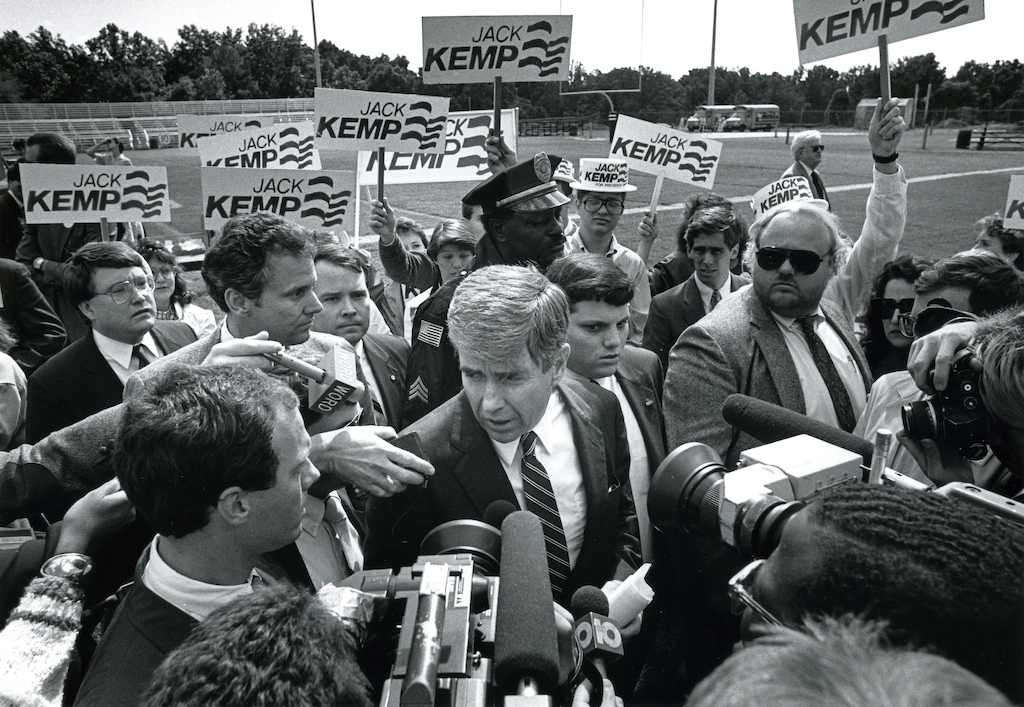
Look at the faces of the people surrounding him. The fat man with the sunglasses, the wiry confused-looking man behind him. The only person who looks bored is the police officer (or security guard?) behind Jack Kemp. That's because his presence is symbolic: it keeps order through its non-intrusiveness, through his absolute refusal to call attention to himself, to act only if someone else acted incorrectly. Almost every large social occasion has many employed workers whose job it is to be invisible, to be nonintrusive. This is especially apparent when, at a club or concert where everyone in the crowd is dancing and moving, the security guards maintain an absolute stone-cold stoicism, and create an expression on their faces which is harsher than usual, to remind themselves that they are not meant to be enjoying the music.
The only moment of visibility is when something goes wrong.

'The speed of the train and the uneventful trip of the passenger are entirely dependent on the complete obedience of the places that are traversed -and also of course on the smooth functioning of the train companies' organization, running, as the saying goes, "like clockwork".' - Bruno Latour, "Trains of Thought"
Subscribe to:
Comments (Atom)